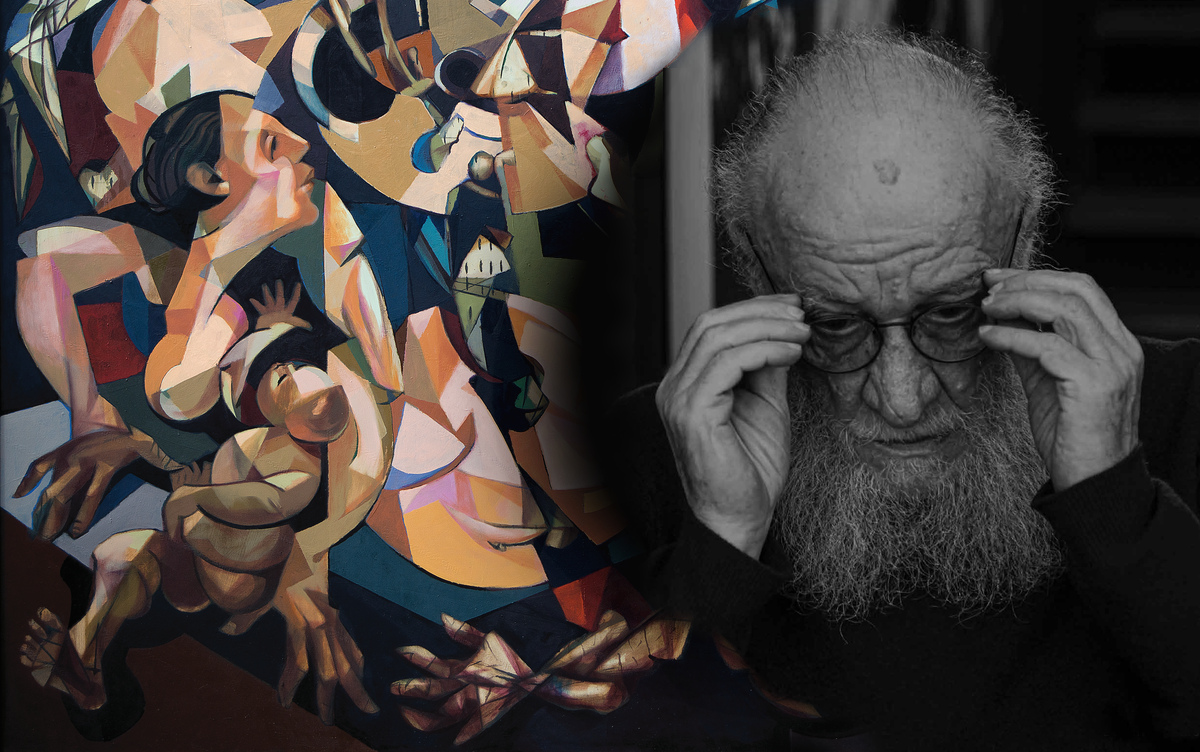
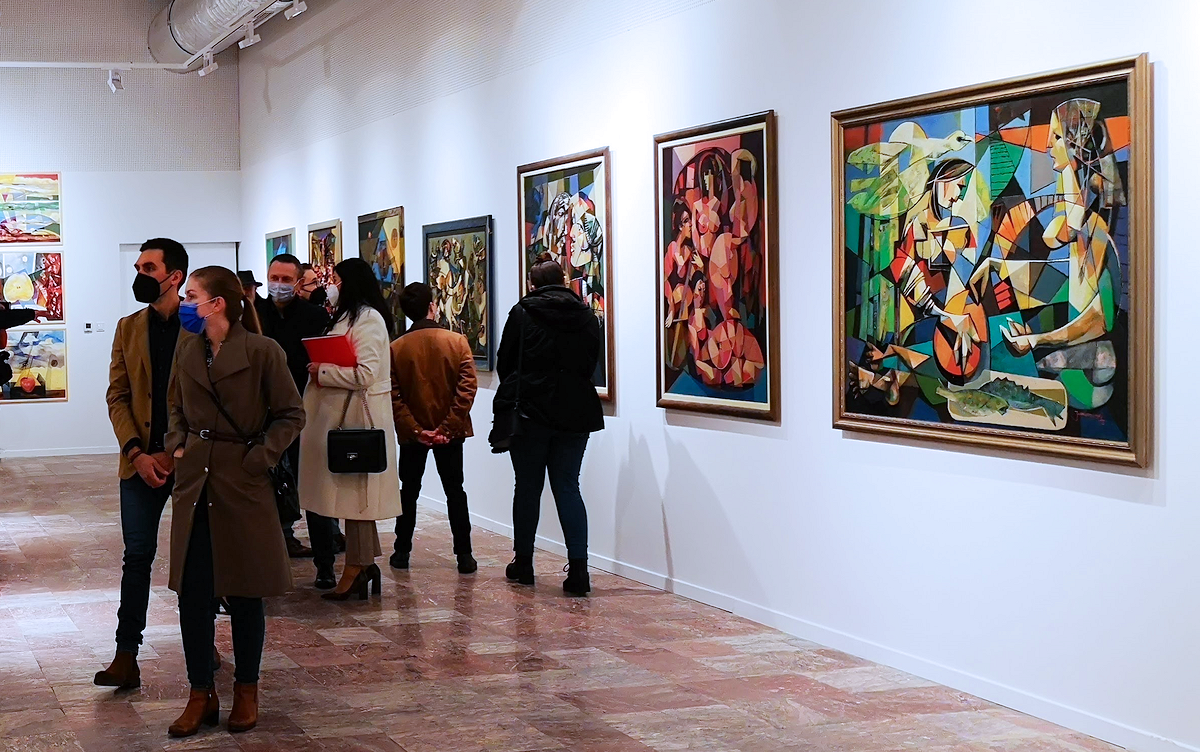
Žarko Jakimovski’s exhibition at MASA is among the most sign...
15/05/2025 | Admin
All Categories

Cubism is one of the most influential movements in 20th-century art. This revolutionary new approach or treatment of visual reality was developed by Pablo Picasso and Georges Braque in the first decade of the century. It was based on the view of the post-Impressionist Paul Cézanne (1839-1906) that any object could be represented artistically through basic geometric forms. The term Cubism comes from the word cube, that is, from the comment of the art historian Louis Vauxcelles who, looking at Georges Braque’s paintings in 1908, concluded that everything there was reduced to geometric outlines, to cubes.
What is the revolutionary nature of the cubist approach? Cubist artists were the first to reject the traditional notion that art should copy nature, i.e. strive to be a mere mirror of it. They ended the painterly practice of creating an illusion of real space, of depth on their canvases. Rather, the Cubists emphasized the two-dimensionality, the flatness of the canvas, while making it a suitable autonomous space for a new treatment of visual reality.

“The Young Ladies of Avignon“, Pablo Picasso (1907)
Hence the reduction and breaking up of the objects in the cubist paintings and their rejoining, but in such a way as to give the viewer different perspectives on the painted object. And so Cubism was the first movement in modern art that consciously broke with painting which sought to create an optical illusion, and with a rational analysis of the elements of reality established an autonomous artistic reality on the canvas, or if you like, an autonomous interpretation of visual reality. With this liberation of art from the imitation of nature, Cubism opened up unlimited possibilities for the artistic treatment of what is seen (with the eyes or with the mind) and accordingly became the precursor of many later artistic movements.
The aforementioned characteristics of Cubism are certainly not just a matter of artistic expression. The Cubists actually wanted to show what the objects were really like, not just what they looked like to the eye. They were thinking about how to offer the viewer a more holistic, more complete, more analytical understanding of the object, the landscape, or the person portrayed, showing them from different angles, from different perspectives (as opposed to the fixed point of view in a traditional painting). They suggested the three-dimensional nature of the subjects without using traditional “tricks” such as perspective or shading.

“Trees at L’Estaque”, Georges Braque (1908) and “Girl with a Mandolin”, Pablo Picasso (1910)
We had to say all this in order to get to the main point of this text, which is our authentic cubism, which was present in Macedonia centuries before the cubism we were talking about appeared. The intersection of this Cubism of ours with the new Cubism of Picasso and Braque finds its most magnificent expression in the canvases of the great Macedonian contemporary artist, Žarko Jakimovski.
To open the topic, we will quote a demonstrative part of an interview with Jakimovski:
“Of the world’s best masters, Georges Braque, Picasso, then the Dutch masters Rembrandt, Vermeer, Hals, then Henri Matisse, and the more modern William de Kooning had the greatest influence on me. It’s a cocktail of what is baroque, traditional, impressionism, cubism. Here I find myself, I search for myself, also through our fresco painting and icon painting. In all my work you can see hints of influences from this European painting that is global. We are talking about a dozen artists who are particularly close to me. I was making a synthesis between what I experienced at my study stays in France, Holland, Germany, Italy, daily analyses of these great masterpieces and ours, which is traditional, iconographic, and I found an extraordinary connection, although it is a difference of three hundred, five hundred years – that frescoes from Kurbinovo, the frescoes of Michael and Eutychios, this is our pure Cubism. So this manuscript of mine, this concept of mine is a mixture. But those roots pulled me more here, and it’s still like that. A synthesis of the European, from the Renaissance, the Baroque, to Cubism, that modern painting, all of that together, and finally most importantly, where am I in all of that? Where is my handwriting, sign, mark?”

“Untitled“, Žarko Jakimovski
This connection that Jakimovski finds between the old, Macedonian Cubism and the new one, is certainly not only artistic, in the geometrization of the objects, i.e. it is not superficial, in the sense of accidental. When we speak of Macedonian Cubism, we are referring primarily to the work of the thirteenth and fourteenth-century Thessalonian zoographers Michael and Eutychios in the churches of St. Mary Perivleptos (Ohrid), St. Nikita (Gornjane) and St. Great Martyr George (Stari Nagorichane). The direct connection between the Cubism of Picasso and Braque and the Cubism of Michael and Eutychios stems from their shared attitude that even when it comes to the visible, reality is not limited to what is visible to the eye.
“Sacred Orthodox art should never be a representation of bare historical reality. The icon and the frescoe always reveal to us the world as it will shine in the future, heavenly reality. Hence the so-called inverse perspective of Byzantine icons and frescoes, the overcoming of natural laws. The icon and the fresco do not work only rationally, for the eyes”, says the famous contemporary icon painter Stamatis Skliris.

Details from the Last Supper and Saint Clement of Ohrid, Michael and Eutychios (13th century)
So, like the new Cubism, the Cubism of said sacred art does not intend to more faithfully, photographically capture historical reality. The icon and the fresco show us through the visible (the portrait of a particular saint) the invisible (sanctity), just as Picasso shows us in some portraits that side of the face that would not be visible if he thought to follow the laws of perspective.

“Detalis of unusual appearance in icons and frescoes, such as oddly shaped ears, are not depicted as a faithful imitation of nature, not because the iconographer could not have depicted them as he saw them, but because if they are as they are in nature, they do not contribute to the purpose of the icon. The point of the icon is not to bring us closer to nature, to delight us with the verisimilitude of what we see with our physical eyes, but to confront us with a human body that has accepted what eludes our ordinary understanding. The idea is to see the spiritual world as well as the physical. And the ascetic experience of the saint often finds its outward expression on the icon in the austerity of the forms, often geometric,” wrote the Russian iconographer and art historian Leonid Uspensky in his famous “Theology of the Icon”.
Žarko Jakimovski’s deep insight into the philosophy of Cubism, i.e. his awareness of the aforementioned links between Macedonian and Western European Cubism, can be seen in his painting. Transferred to the canvas with supreme skill and artistic erudition, this is an important aspect of this artist’s uniqueness.
That is why Acad. Vlada Urosević in his address at the opening of the major retrospective exhibition of Jakimovski at Macedonian Academy of Sciences and Arts (MASA) will say:
“Žarko Jakimovski is undoubtedly an artist who thinks through painting, and who, through the process of creation, wants to find answers to some essential problems, the nature of which goes far beyond those questions that concern only the field of artistic expression. With the passion of an almost scientific approach that we could call vivisection in the visible world, Jakimovski’s painting becomes a kind of operating table or laboratory for microscopic analysis.”

“Untitled“, Žarko Jakimovski